
Crowns and bridges
A crown is a cap that covers a damaged tooth. A bridge replaces a missing tooth with a false one held in place by crowns on the teeth on either side. Both are made to match your other teeth.
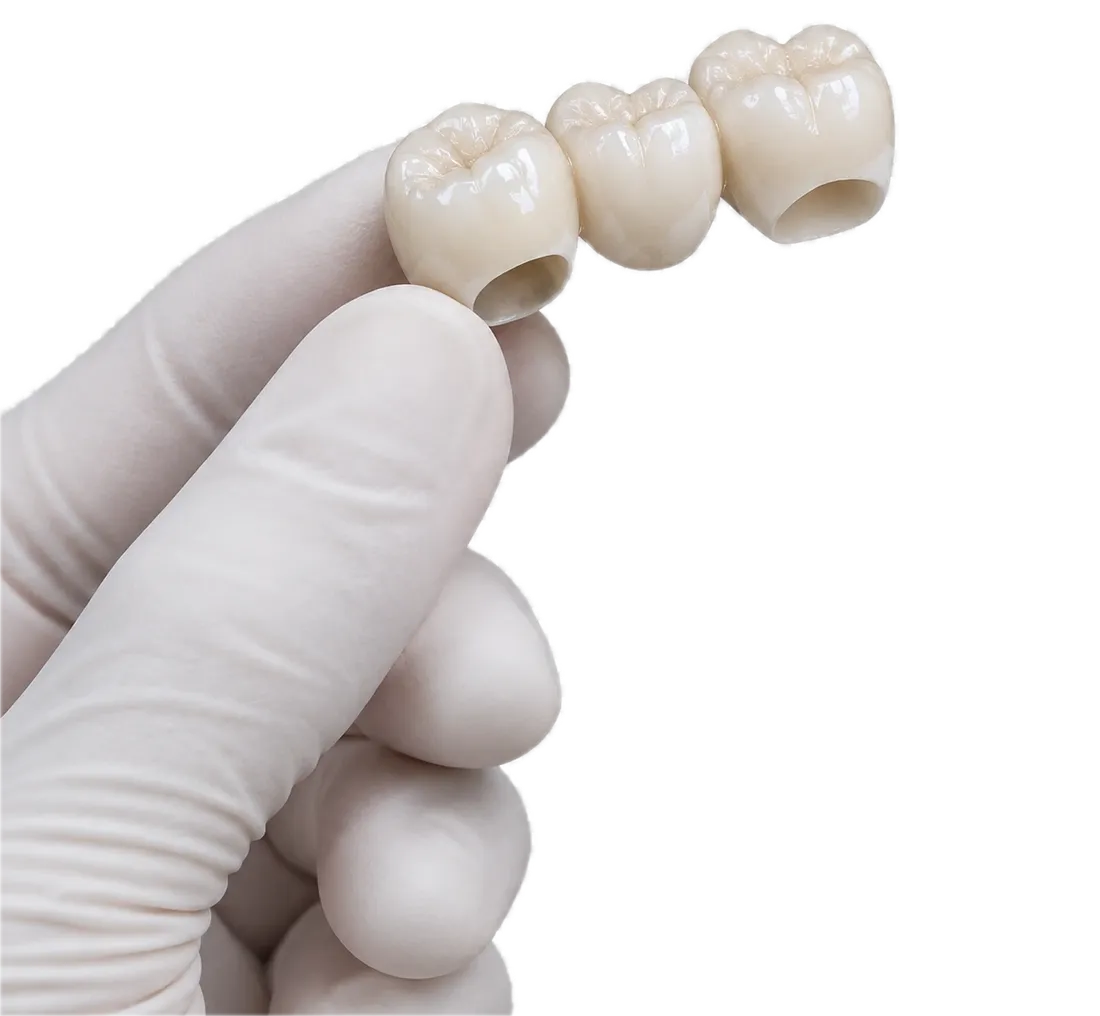
What crowns and bridges are
A crown can make a tooth stronger and improve how it looks (ADA). Crowns are made of metal, porcelain fused to metal, all-ceramic materials such as zirconia, or resin. Resin is often used for temporary crowns (Cleveland Clinic).
A bridge fills a gap with one or more false teeth. The common type holds the false tooth between crowns on the teeth either side. Other types are held by a crown on one side only, by metal wings bonded to the backs of the neighboring teeth, or by dental implants (Cleveland Clinic).
Who they are for
A dentist may suggest a crown to (ADA):
- support a tooth that has too little of its own structure left to hold a large filling
- protect a weak or cracked tooth, or restore a broken one
- cover a badly shaped or discolored tooth
- cover a dental implant or hold a bridge in place
Teeth treated with a root canal often get a crown too (Cleveland Clinic). For a missing tooth, the main alternatives to a bridge are an implant or a partial denture (Cleveland Clinic).
What happens
- Preparing the tooth. The dentist numbs the area and removes some enamel so the crown fits. Some filling material may be added to build the tooth up (Cleveland Clinic). For a bridge, the teeth either side are reshaped. This step cannot be undone (Cleveland Clinic).
- Impression or scan. The dentist takes an impression or digital scan, and you leave with a temporary crown or bridge (Cleveland Clinic).
- Lab work. A lab usually returns a crown in two to three weeks (Cleveland Clinic). A bridge usually takes two to four weeks (Cleveland Clinic).
- Fitting. At the second visit, the dentist removes the temporary, checks the fit and color, and cements the final crown or bridge (Cleveland Clinic).
Some practices design and mill a ceramic crown in the office, so it can be fitted in one visit. Not everyone is a candidate (Cleveland Clinic).
Aftercare
- Some sensitivity to hot and cold is normal for a couple of weeks, and sore gums usually settle within a few days (Cleveland Clinic).
- Avoid chewing ice, very hard nuts and sticky candy (Cleveland Clinic).
- Brush twice a day and floss daily. Clean under a bridge every day with a floss threader or small brushes made to fit between teeth (Cleveland Clinic).
- If you grind your teeth, ask about a custom mouth guard (Cleveland Clinic).
- Call your dentist if a crown feels loose, chips or has a sharp edge, or if you notice a bad taste (Cleveland Clinic).
Risks and how long they last
Possible problems include sensitivity, a chipped or loose crown and, rarely, an allergic reaction. A crown that does not fit well can trap bacteria and lead to decay (Cleveland Clinic). With a bridge, decay or damage to the supporting teeth can weaken it, and a bridge may break if it has to be removed (Cleveland Clinic).
The figures below come from systematic reviews. They describe groups of patients, not what will happen to you.
- Crowns. About 95% of porcelain-fused-to-metal crowns were still in place after five years. Most all-ceramic crowns did about as well. Zirconia crowns had more technical problems, such as chipping of the outer layer and coming loose (Sailer 2015).
- Bridges. About 94% of porcelain-fused-to-metal bridges were still in place after five years. All-ceramic bridges did somewhat less well, at about 86% to 90% (Pjetursson 2015).
Cleveland Clinic says crowns and bridges typically last 5 to 15 years with good care (Cleveland Clinic).
What affects the cost
- The material, and whether it is made in a lab or milled in the office.
- How many teeth are involved. A bridge includes the crowns on the supporting teeth as well as the false teeth.
- Any build-up, post or root canal the tooth needs first.
- The temporary crown or bridge.
- What your dental plan covers, and any yearly maximum.
Ask for a written estimate that lists each tooth and each item separately, with its CDT code (ADA). Ask your dentist to send a pre-treatment estimate to your insurer before you start.
Questions to ask your dentist
- Why does this tooth need a crown rather than a filling?
- Which material do you suggest for this tooth, and why?
- Can it be done in one visit?
- For a bridge: what will happen to the teeth on either side? Would an implant or a partial denture suit me?
- How do I clean around it?
- What happens if it comes loose or breaks, and who pays?
General information only. This guide is not medical advice and does not replace an exam by a licensed dentist. Results vary.