
Dental implants
A dental implant is a small post, usually titanium, placed in the jawbone to hold a replacement tooth. Implants can replace one tooth, several teeth or a full arch. Treatment happens in stages over several months, because the bone has to grow around the post before the final tooth goes on.
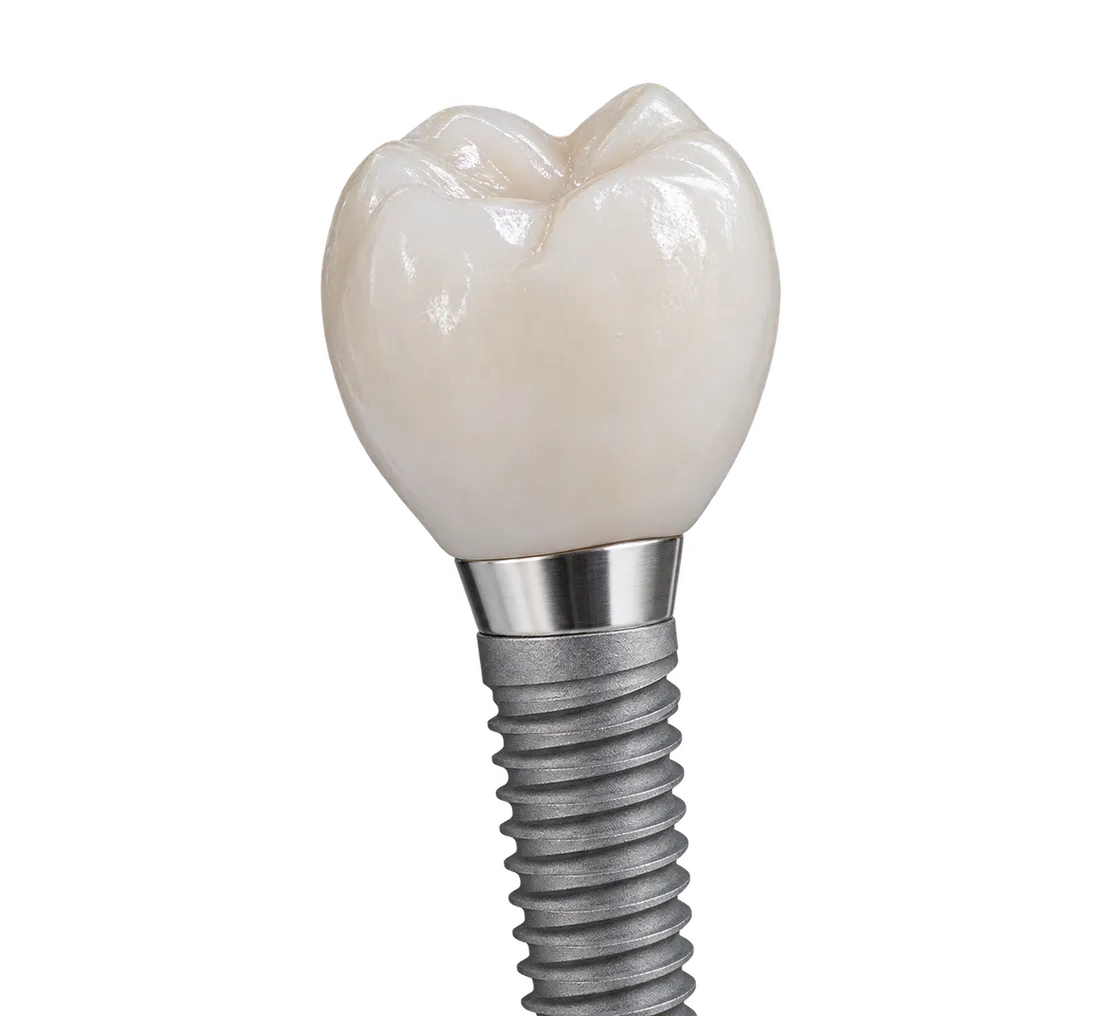
What a dental implant is
A dental implant replaces the root of a missing tooth. A dentist places it in the jawbone, and a replacement tooth is attached once the bone has healed. A finished implant tooth has three parts.
| Part | What it is |
|---|---|
| Implant | A small screw-shaped post placed in the jawbone. Implants are usually made of titanium. Some are made of a ceramic called zirconia. |
| Abutment | A connector that joins the implant to the replacement tooth. It sits at the gum line. |
| Crown or prosthesis | The part you see and chew with. One implant usually holds one crown. Several implants can hold a bridge or a full set of teeth. |
Over the months after surgery, bone grows tightly against the surface of the implant. Dentists call this osseointegration. It is what lets an implant carry chewing forces (Cleveland Clinic).
In the United States, implant systems are regulated as medical devices. Before a company can sell one, it must show the FDA that the system is as safe and as effective as systems already on the market (FDA). There are many brands, and parts are not always interchangeable between them. That is one reason to know which system you have.
Who can have implants
Many adults with one or more missing teeth can have implants, but not everyone. A dentist decides after an exam and imaging. These factors affect whether implants suit you and how likely they are to succeed.
| Factor | What to know |
|---|---|
| Gum health | Active or untreated gum disease needs treatment before implant surgery (Cleveland Clinic). The FDA lists untreated gum disease among implant complications (FDA). |
| Jawbone | Bone shrinks after a tooth is lost. Severe bone loss can rule out implants or mean you need a bone graft first (Cleveland Clinic). |
| Smoking and vaping | Smoking can slow healing and lower the long-term success of an implant (FDA). In a 2021 systematic review, implants in smokers had about 2.4 times the odds of failing compared with implants in non-smokers (Mustapha 2021). Cleveland Clinic also lists vaping as a concern. |
| Diabetes | Uncontrolled diabetes makes infection more likely, which can lead to implant failure (FDA). Ask your doctor whether your blood sugar is under control before you plan surgery. |
| Bone medicines (antiresorptives) | Bisphosphonates and denosumab are linked to a rare but serious problem called medication-related osteonecrosis of the jaw (MRONJ), where an area of jawbone does not heal. It usually follows an extraction or other surgery in the jaw (ADA). At the doses used for osteoporosis, the ADA describes the risk as low, about 0.1%, and says these medicines do not appear to rule out implants (ADA). The risk is higher at the doses used to treat cancer: the ADA cites 1% to 10% for intravenous bisphosphonates given for cancer that has spread to bone, and the oral surgery guidance it summarizes says implants should not be placed during that treatment (ADA). Do not stop a prescribed medicine on your own. Tell your dentist and the doctor who prescribed it, so they can plan together. |
| Daily cleaning | Poor oral hygiene and extensive tooth decay are concerns (Cleveland Clinic). Implants need cleaning every day. |
| Age | Implants are usually placed only after the jaw has stopped growing. Cleveland Clinic gives 18 as the typical minimum age. |
| Other health conditions | Your overall health matters (FDA). Tell your dentist about every condition and medicine, including blood thinners and any past radiation treatment to the head or neck. |
The steps and a typical timeline
Implant treatment happens in stages over several months. Your plan may skip some steps or add others.
-
Consultation, exam and imaging
The dentist reviews your health history, examines your mouth and takes x-rays. Many dentists also use a 3D scan called cone-beam CT (CBCT) to plan where each implant will go. CBCT usually gives more radiation than regular dental x-rays, so the FDA suggests asking whether the scan is needed and whether an option with less radiation would do (FDA). You should leave with a written treatment plan and an itemized estimate.
-
Extractions and grafting, if needed
Teeth that cannot be saved are removed. If the bone is too thin, the dentist may add a bone graft. In the upper back jaw, a sinus lift adds bone below the sinus. Some grafts are placed at the same visit as the implant. Others need to heal first. Ask how long your dentist expects the graft to take to heal.
-
Implant placement
The area is numbed, and some practices also offer sedation. The dentist opens the gum, prepares the bone and places the implant. Slight discomfort and swelling afterwards are normal, and the first round of healing takes about a week (Cleveland Clinic).
-
Healing
The bone needs time to bond with the implant. This can take three to nine months (Cleveland Clinic). You may wear a temporary tooth or denture in the meantime, especially for front teeth.
-
Abutment and final teeth
Once the implant is stable, the abutment is attached. This may need a second minor surgery. The dentist takes impressions or a digital scan, a dental lab makes the crown, bridge or denture, and the dentist fits it (Cleveland Clinic).
-
Follow-up
Expect check-ups after treatment and regular dental visits after that (FDA).
| Stage | Typical time |
|---|---|
| Planning and imaging | One or more visits |
| Healing after extractions or grafts | Varies. Ask your dentist for an estimate in writing. |
| Gum healing after implant surgery | About one week for the first round of healing |
| Bone healing around the implant | Three to nine months |
| Fitting the abutment and final teeth | One or more visits |
| Whole treatment | Several months or longer (FDA). Grafting adds time. |
Some practices fit temporary teeth on the day of surgery. Dentists call this immediate loading. The bone still needs months to heal, and the final teeth come later. Ask whether it suits your case, and why.
Implant options and alternatives
| Option | What it is | Things to weigh |
|---|---|---|
| Single implant and crown | One implant holds one crown. | Does not involve the neighboring teeth. Needs surgery and months of healing. |
| Several single implants | Each missing tooth gets its own implant and crown. | More implants mean more surgery and more cost than a bridge on fewer implants. |
| Implant-supported bridge | Two or more implants hold a bridge that replaces several teeth in a row. | Uses fewer implants than missing teeth. A problem with one implant can mean work on the whole bridge. |
| Full-arch fixed teeth | Several implants hold a full arch of teeth that only the dentist can remove. | A large treatment. Cleaning under the bridge takes extra care and tools. Repairs need a dental visit. |
| Implant-supported denture | A removable denture that clips onto two or more implants. Also called an overdenture. | More stable than a standard denture, and you can take it out to clean it. The clips wear and need replacing from time to time. |
| Alternative | What it is | Things to weigh |
|---|---|---|
| Tooth-supported bridge | Crowns on the teeth either side of the gap hold a false tooth between them. | No implant surgery and usually a shorter treatment. The neighboring teeth must be reshaped for crowns. It does not replace the root. |
| Removable partial or full denture | A plate with false teeth that you take out. | No surgery and usually the least treatment. It can move when you eat or talk, and it needs adjusting as the gums change. |
| Leaving the space | No replacement. | Ask your dentist what is likely to happen to the nearby teeth and your bite. |
The FDA says implants help keep the jawbone from shrinking and help keep nearby teeth stable (FDA). Bridges and dentures do not replace the root. Ask your dentist to go through every option, including ones without implants.
Our guides to crowns and bridges and dentures explain those options in more detail.
Outcomes and risks
Implants involve surgery, and things can go wrong. The figures below come from systematic reviews, which pool the results of many studies. They describe groups of patients, not what will happen to you.
How long implants last
A 2019 systematic review of studies with 10 years of follow-up estimated that 96.4% of implants were still in place after 10 years (95% confidence interval 95.2% to 97.5%). A more cautious analysis in the same review gave 93.2%, and survival was lower in people aged 65 or older, at 91.5% (Howe 2019).
"Still in place" does not mean free of problems. The crown, screws and other parts can loosen, wear or break and may need repair or replacement over time.
Gum and bone problems around implants
Gums can become inflamed around implants, as they can around teeth. Peri-implant mucositis is inflammation of the gum only. Peri-implantitis is inflammation with loss of the bone that supports the implant, and it can lead to losing the implant.
A 2015 systematic review estimated that 43% of patients had peri-implant mucositis (confidence interval 32% to 54%) and 22% had peri-implantitis (14% to 30%) (Derks and Tomasi 2015). A 2022 review estimated peri-implantitis in 19.5% of patients and 12.5% of implants (Diaz 2022). So in these studies, about one in five people with implants had peri-implantitis. Ask your dentist how to clean around your implants and how often to come in for checks.
Risks during and after surgery
The FDA lists these risks and complications (FDA):
- Numbness after surgery caused by pressure on or damage to a nerve. In the lower jaw, a nerve runs through the bone, which is one reason dentists plan implant position with imaging. Ask how long numbness could last and what would be done about it.
- Injury to nearby tissues, such as a hole into the sinus when implants are placed in the upper back jaw.
- Damage to nearby natural teeth, or a fracture of the jawbone during surgery.
- Infection in the bone and gum around the implant.
- A bite that does not feel right, or a tooth that feels loose or twists because an abutment screw has loosened.
- Difficulty cleaning the gum around the implant.
- Failure of the implant.
People who take certain bone medicines also have a risk of MRONJ, described in who can have implants.
When an implant fails
An implant fails when it does not bond with the bone, or loses that bond later and becomes loose (FDA). Infection, smoking and uncontrolled diabetes raise the risk. A failed implant is usually removed. Another implant may be possible once the area heals, sometimes after a graft. Failure can leave less bone to work with, so ask before you start what the plan would be if an implant fails, and who would pay.
Warning signs
Contact your dentist right away if an implant feels loose or painful (FDA), or if you notice bleeding gums, fever, pus or swelling around it (Cleveland Clinic).
Aftercare
- Follow the cleaning instructions your dentist gives you (FDA). Brush twice a day, and clean around implants with floss, small brushes that fit between teeth or a water flosser, as your dentist shows you.
- Keep regular check-ups and professional cleanings (FDA).
- If you smoke, ask for help to stop. Smoking affects healing and long-term success (FDA).
- If you grind or clench your teeth, ask whether you need a night guard.
- Keep a record of the brand and model of each implant, as the FDA advises, along with its size and lot number.
- Tell any new dentist that you have implants, and share your records.
- Tell your doctors and imaging staff about your implants before an MRI or an X-ray. Implants can distort the images (FDA).
If you have a problem with an implant, tell your dentist. You can also report it to the FDA through its MedWatch program (FDA).
What drives the cost
Two plans for the same mouth can differ a lot. Ask for an itemized quote so you can compare like with like.
- How many teeth are replaced, and how many implants are used.
- Whether you need extractions, bone grafts or a sinus lift.
- Imaging, such as a CBCT scan.
- The type of final teeth (a single crown, a bridge, a full arch or a denture) and the materials.
- Whether the abutment is a standard part or custom-made.
- Sedation or anesthesia beyond local numbing.
- Temporary teeth while you heal.
- The number of visits, the lab work and the follow-up care.
- Local costs where the practice is.
Itemized quote checklist
Ask for a written, itemized estimate before you agree to treatment. It should cover each of these lines, or say that it does not apply to you.
| Item | What the quote should show |
|---|---|
| Exam and consultation | The fee, and whether it counts toward treatment. |
| Imaging | X-rays and any CBCT scan, with their fees. |
| Extractions | Each tooth to be removed. |
| Bone graft or sinus lift | Where, which graft material, and whether it is a separate surgery. |
| Implants | The number of implants, with brand, model and size. |
| Abutments | Standard or custom-made, and the brand. |
| Crown, bridge or denture | The type, the material and the number of teeth. |
| Sedation | The type of sedation and its fee. |
| Temporary teeth | What you will wear while you heal, and its fee. |
| Follow-up visits | Which visits are included, and for how long. |
| If something fails | Who pays to replace a failed implant or a broken tooth, for how long, and under what conditions. Get these warranty terms in writing. |
| Payment terms | The deposit, the payment schedule, and the refund terms if you stop treatment. |
Ask for the dental procedure code (CDT code) next to each line. Insurers use these codes, and they make quotes from different practices easier to compare (ADA).
Insurance, HSA/FSA and financing
Dental insurance
Coverage for implants varies from plan to plan. Before you start, ask your plan:
- Does it cover implants, or only some parts, such as the crown?
- Is there a yearly maximum, and how much of it is left this year?
- Is there a waiting period?
- Does it exclude teeth that were missing before your coverage began?
Ask your dentist to send a pre-treatment estimate to your insurer. It shows what the plan expects to pay before you commit.
Original Medicare does not cover most dental care. Medicare.gov lists dentures and implants among the services it does not cover in most cases (Medicare.gov). If you have a Medicare Advantage plan, ask the plan what dental care it covers.
HSA and FSA
Money in a health savings account (HSA) can generally pay for medical care as the tax code defines it. Health flexible spending arrangements (FSAs) and health reimbursement arrangements (HRAs) cover costs that would generally qualify for the medical and dental expense deduction, within each plan's own rules (IRS Publication 969).
IRS Publication 502 explains which dental costs qualify. It includes amounts paid to prevent and treat dental disease and for artificial teeth. It excludes teeth whitening and, in general, cosmetic surgery (IRS Publication 502). Check with your plan administrator or a tax professional before you pay.
Financing
Some practices offer payment plans, medical credit cards or loans from other companies. The CFPB has reported that medical credit cards and financing plans can leave patients paying more than they otherwise would (CFPB). Before you sign:
- Read the APR, the length of any promotional period and the total you will repay.
- Check for deferred interest. With a deferred-interest offer, if you have not paid the full balance by the end of the promotional period, you are charged interest back to the date of purchase (CFPB).
- Check the late fees and what happens if you miss a payment.
- Take the paperwork home and decide when you are ready. You do not have to sign on the day of your consultation.
Vwellny does not offer or arrange financing.
How to check a dentist
- License. Each state has its own dental board. Look the dentist up with your state board's license search and check for disciplinary actions. The ADA keeps a directory of state dental boards (ADA).
- Who places and who restores. Ask who will place the implants and who will make and fit the teeth. Sometimes one dentist does both. Sometimes two dentists share the work. Ask how often each of them treats cases like yours.
- Training and titles. General dentists place implants, and so do dentists in some ADA-recognized specialties, such as oral and maxillofacial surgery, periodontics and prosthodontics. Implant dentistry is not one of the 12 recognized dental specialties (National Commission). Course certificates and memberships show extra training, but they are not a specialty.
- Sedation. If you will be sedated, ask what kind of sedation and whether the dentist holds the state permit for it, where your state requires one.
- Implant system in writing. Ask for the brand, model, size and lot number of each implant, and keep them with your records (FDA).
- A written, itemized estimate. Use the quote checklist above.
- Written aftercare and warranty terms. What follow-up is included, what happens if an implant fails or a crown breaks, and who pays.
- Your records. Under HIPAA, you generally have the right to a copy of your records, including x-rays and scans, from a dental practice covered by the law. The practice can charge only a limited, cost-based fee (HHS).
Questions to ask
- Am I a candidate for implants, and what are my other options?
- What does my imaging show about my bone? Do I need a graft or a sinus lift?
- Who will place the implants, and who will make and fit the teeth?
- How many cases like mine do you treat each year?
- Which implant system will you use, and can another dentist service it if I move?
- What are the risks in my case, and how would you handle a complication?
- How many visits will I need, and how long will the whole treatment take?
- What will I wear while I heal?
- What does the quote include, and what could add to it?
- What happens if an implant fails or a crown breaks, and who pays?
- How should I clean my implants, and how often should I come back?
- Can I have copies of my x-rays, scans and treatment plan?
When to get a second opinion
A second opinion is normal before a large treatment. Consider one when:
- The plan removes teeth you did not expect to lose, or replaces a full arch.
- The plan or the price is much larger than you expected.
- You feel pressure to decide or pay on the same day, or you are told a discount is about to end.
- The dentist cannot clearly explain why you need a graft, a sinus lift or a particular option.
- You have health conditions or take medicines that raise your risk.
- Quotes from different practices differ a lot and you cannot see why.
- Something does not feel right after surgery, such as pain, numbness or a loose implant that is not getting better.
Bring copies of your imaging and treatment plan. The second dentist may still need to take new images.
Treatment abroad
Some people travel to another country for implants. Dentists abroad are licensed under that country's rules, not by a US state board. The CDC notes that oversight differs, and that you may have less legal recourse if something goes wrong (CDC). Treatment takes several months, so plan for more than one trip and for care once you are home.
If you are considering it, read our guide to dental care abroad. It explains what to check before you book and why to see a dentist at home before and after you go.
General information only. This guide is not medical, dental, tax or financial advice, and it does not replace an exam by a licensed dentist. Results vary. If you have severe pain, swelling, fever or bleeding after dental surgery, contact your dentist or get urgent care.