
Braces
Braces straighten teeth with brackets fixed to each tooth and a wire your orthodontist adjusts every few weeks. They can be metal, tooth-colored ceramic, or fitted behind the teeth. After braces come off, you wear a retainer to keep teeth in place.
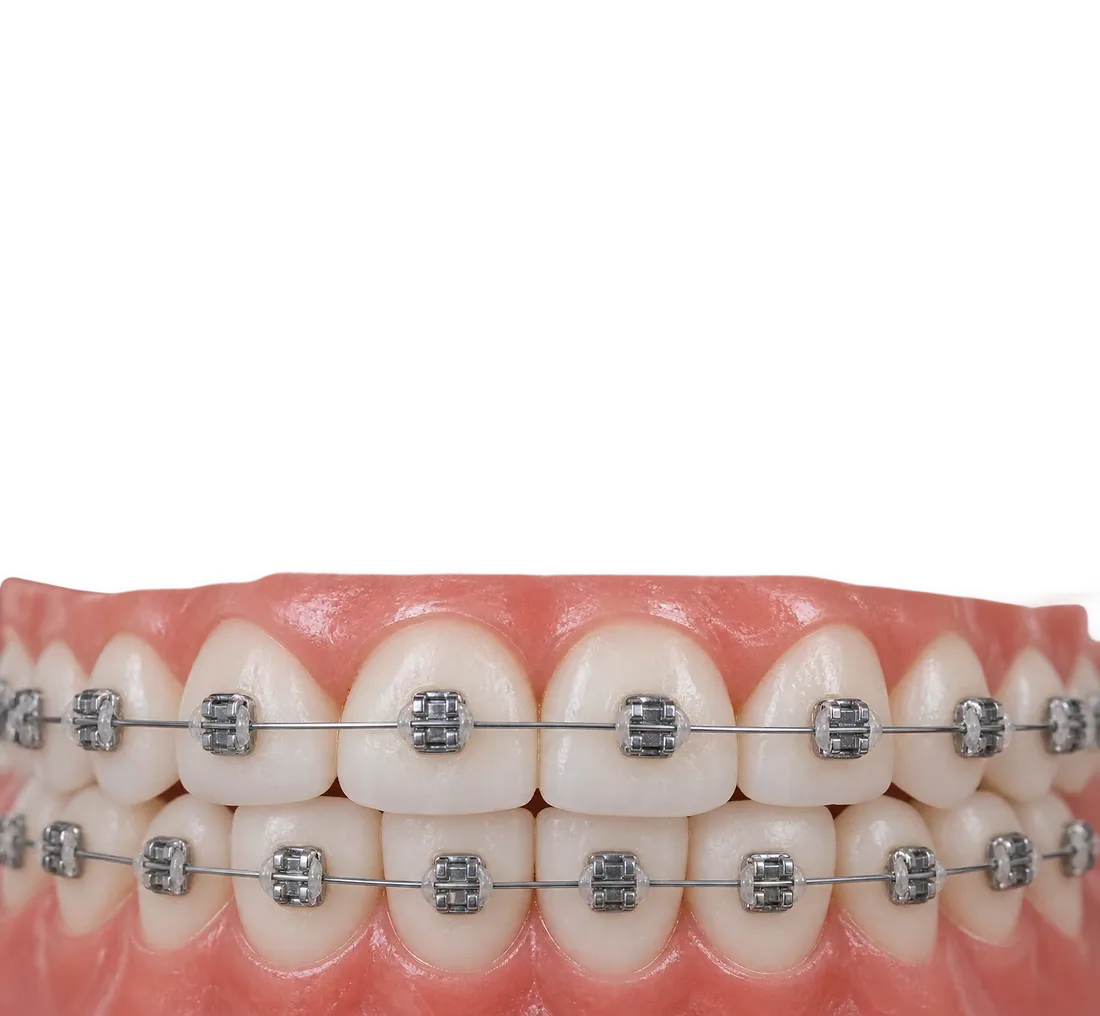
How braces work
Braces are fixed to your teeth for the length of treatment. Small brackets are bonded to the teeth and joined by a wire. The wire puts gentle, steady pressure on the teeth and shifts them over time (Cleveland Clinic).
Braces can treat crowded, crooked, overlapping and rotated teeth, as well as bite problems such as an overbite or an underbite (Cleveland Clinic).
Cleveland Clinic says ages 9 to 14 are generally the ideal time for braces, while the jaw is still growing. Adults can have braces too. They are often just as effective, but treatment may take longer (Cleveland Clinic). Cavities, gum disease and gum recession need treatment before braces go on (Cleveland Clinic).
Types of braces
| Type | What it is | Things to weigh |
|---|---|---|
| Metal | Stainless steel brackets bonded to the teeth and joined by a wire (Cleveland Clinic). | The most visible type. Stronger than ceramic brackets (Cleveland Clinic). |
| Ceramic (clear) | Tooth-colored brackets that work the same way as metal braces (Cleveland Clinic). | Less noticeable. More fragile and more likely to stain than metal, and usually cost more (Cleveland Clinic). |
| Lingual | Brackets bonded to the back surfaces of the teeth instead of the front (Cleveland Clinic). | Hidden from view. A 2013 review found more tongue soreness and more trouble speaking than with braces on the front of the teeth, but less soreness of the cheeks and lips (Long 2013). |
| Self-ligating | Look like metal braces, but a built-in clip holds the wire instead of small elastic ties (Cleveland Clinic). | Ask your dentist why they suggest this type for your case. |
Some plans also use other appliances, such as elastics, springs or a palate expander. Ask what each one is for and how long you will need it.
Braces or clear aligners
Clear aligners are removable plastic trays that also straighten teeth. A 2019 systematic review found both braces and aligners were effective. Braces were better at making the upper and lower teeth meet properly, controlling the angle of the roots, widening the arch and holding results. Aligner treatment was shorter on average (Ke 2019). The review included only eight studies.
Which one suits you depends on how your teeth need to move, how you feel about wearing removable trays for most of the day, and what you want to see in the mirror. Our guide to clear aligners explains the other option in detail.
The steps and how long it takes
-
Exam, X-rays and records
The dentist or orthodontist examines your teeth, gums, bite and jaws, and takes X-rays, photos and a scan or impressions.
-
Treatment plan and quote
You should get a written plan that names the type of braces, any other appliances or tooth removal, how long treatment should take and an itemized quote.
-
Placing the braces
Brackets are bonded to your teeth and the wire is fitted. Expect some discomfort for a few days afterwards (Cleveland Clinic).
-
Adjustment visits
You visit regularly so the wires can be adjusted and the braces checked (Cleveland Clinic). Teeth may feel sore for a day or so after each adjustment.
-
Removal and retainers
When the teeth reach their planned position, the braces come off and you start wearing a retainer. See after braces.
| Measure | What sources say |
|---|---|
| Typical length | About two years on average. Some people finish in under 12 months, others need up to three years (Cleveland Clinic). |
| Research average | 19.9 months and about 18 visits, in a 2016 review of prospective studies carried out in university settings (Tsichlaki 2016). |
| Ceramic braces | 12 to 36 months (Cleveland Clinic). |
| Adults | May take longer than for children and teens (Cleveland Clinic). |
| Retainers | Continue after the braces come off. |
Living with braces
- Brush at least twice a day with a soft-bristled toothbrush and fluoride toothpaste, and floss around your braces once a day (Cleveland Clinic). Floss threaders and small brushes that fit between teeth can help (Cleveland Clinic).
- Avoid hard and sticky foods for as long as you wear braces, such as nuts, caramels and hard, crunchy fruits and vegetables (Cleveland Clinic).
- With ceramic braces, coffee, tea, red wine, tomato sauce and soy sauce can stain the brackets (Cleveland Clinic).
- Keep up your regular dental checkups and cleanings (Cleveland Clinic).
- If you play contact sports, ask about a mouthguard that fits over braces.
- Call the practice about pain that does not go away, a broken wire or bracket, an injury to your mouth or face, or bleeding or infection in your gums (Cleveland Clinic). Ask at the start what to do out of hours.
Risks and side effects
Some side effects of braces can last.
White spots and cavities
Plaque and tartar can build up around brackets and wires and lead to cavities and gum inflammation (Cleveland Clinic). Early decay often shows up as chalky white spots on the teeth. A 2015 meta-analysis of 14 studies found that 45.8% of patients developed new white spot lesions during treatment with braces (Sundararaj 2015). Careful cleaning and fluoride help. Ask your dentist what else they recommend for you.
Root resorption
Moving teeth can shorten their roots slightly. A systematic review found that comprehensive orthodontic treatment increases how often this happens and how much, and that heavy forces may be particularly harmful (Weltman 2010). Ask whether you will have X-rays during treatment to check your roots.
Other side effects
- Soreness for a few days after the braces go on and after adjustments (Cleveland Clinic).
- Irritation of the tongue, lips or inner cheeks (Cleveland Clinic).
- Jaw pain and difficulty eating, especially after adjustments (Cleveland Clinic).
- With lingual braces, tongue soreness and trouble speaking (Long 2013).
- With ceramic braces, brackets that break more easily (Cleveland Clinic).
- Teeth drifting back after treatment if retainers are not worn (Cleveland Clinic).
After braces: retainers
Everyone who has braces needs a retainer afterwards (Cleveland Clinic). Without one, teeth tend to move back toward their old positions. This is called relapse (Cochrane review).
| Type | What it is |
|---|---|
| Clear plastic | A removable clear tray molded to your teeth (Cleveland Clinic). |
| Wire and acrylic | A removable plastic or acrylic retainer with a wire, often called a Hawley retainer (Cleveland Clinic). |
| Fixed (bonded) | A wire bonded to the teeth with a glue-like material, so it stays in place (Cleveland Clinic). |
Instructions vary. Cleveland Clinic describes a common pattern: wearing the retainer day and night for at least four to six months, then at night with no set end date (Cleveland Clinic).
A 2023 Cochrane review of 47 studies rated the evidence as low or very low certainty, so it could not show that any one type of retainer works better than another. Each type has trade-offs in comfort, breakage and gum health (Cochrane review). Ask your dentist which type they suggest for you and why, and what a replacement costs.
Orthodontist or general dentist
- Orthodontist. In most cases, orthodontists provide braces (Cleveland Clinic). Orthodontics and dentofacial orthopedics is one of 12 dental specialties recognized in the United States (National Commission). Orthodontists complete two to three years of extra training after dental school (Cleveland Clinic).
- General dentist. Some general dentists also offer braces. Ask how many orthodontic cases they treat each year, and when they refer patients to an orthodontist.
- License. Look up any dentist on your state dental board's license search. The ADA keeps a directory of state boards (ADA).
What drives the cost
Compare written, itemized quotes, not headline prices.
- The type of braces. Ceramic braces usually cost more than metal (Cleveland Clinic).
- How complex the case is, and how long treatment lasts.
- Records such as X-rays, photos and scans.
- Other appliances, such as a palate expander or elastics.
- Tooth removal or other dental work needed first.
- Visits for broken brackets or wires.
- Retainers after treatment, and replacements.
- Local costs where the practice is.
Itemized quote checklist
Ask for a written, itemized estimate before you agree to treatment. It should cover each of these lines, or say that it does not apply to you.
| Item | What the quote should show |
|---|---|
| Exam and records | X-rays, photos and scans, and whether the fee counts toward treatment. |
| Braces | The type of braces and the expected length of treatment. |
| Adjustment visits | Whether all regular visits are included. |
| Other appliances | Any expander, elastics or other appliances, with their fees. |
| Repairs | Whether visits for broken brackets or wires cost extra. |
| Retainers | The type, how many are included, follow-up visits and the price of a replacement. |
| If treatment runs long | Whether extra months cost more. |
| If treatment stops | The refund or transfer terms if you stop or move away. |
| Payment terms | The deposit, the payment schedule and any interest. |
Insurance, HSA/FSA and financing
Dental insurance
Orthodontic coverage varies from plan to plan. Before you start, ask your plan:
- Does it cover orthodontic treatment for adults, or only for children?
- Is there a separate maximum for orthodontic treatment, and how is it paid out?
- Is there a waiting period?
- Does it cover retainers?
HSA and FSA
IRS Publication 502 lists braces among the dental costs that count as medical expenses (IRS Publication 502). An HSA or health FSA can generally pay for qualifying medical expenses, within each plan's rules (IRS Publication 969). Check with your plan administrator before you pay.
Financing
Some practices offer payment plans. If you are offered a payment plan, a medical credit card or a loan, read the APR, the promotional period and the total you will repay. With a deferred-interest offer, if you have not paid the full balance by the end of the promotional period, you are charged interest back to the date of purchase (CFPB). Vwellny does not offer or arrange financing.
Questions to ask
- Which type of braces suits my case, and why?
- Would clear aligners work for me? Why or why not?
- How long should treatment take, and how often will I visit?
- Will I need teeth removed or other appliances?
- Who will adjust my braces at each visit?
- What should I do if a bracket breaks or a wire pokes my cheek?
- How will you check for white spots and changes to my roots during treatment?
- What does the quote include, and what could add to it?
- What retainer will I need, how long should I wear it, and what does a replacement cost?
- What happens if we move during treatment?
- Can I have copies of my X-rays, records and treatment plan?
Under HIPAA, you generally have the right to a copy of your records from a dental practice covered by the law, for a limited, cost-based fee (HHS).
General information only. This guide is not medical, dental, tax or financial advice, and it does not replace an exam by a licensed dentist or orthodontist. Results vary. If you have severe pain or swelling, or a broken wire that cuts your mouth, contact your dentist.